Soul of Satoshi
PUBLIC TESTNET LIVEMAINNET CANDIDATE IN VALIDATION

Programmable money.
Post-quantum by design.

A post-quantum settlement network for SOS, stable assets and programmable applications. Transparent by default, private by choice, connected to Ethereum without trusted custodians.

21M hard cap|Public testnet live|Vesting enforced on-chain|Verifiable public releases

SOS protocol architecture

Post-Quantum Security

ML-DSA-65 signatures. ML-KEM-1024 key exchange. NIST FIPS 203/204 standardized. Every signature, every key exchange, every proof—quantum-resistant from day one.

FIPS 204FIPS 203NIST L3

Optional Privacy

PQ-MWEB extension blocks with STARK proofs. Shield your balance when you want. Transparent by default, private by choice. Always your decision.

PQ-MWEBSTARKsOpt-in

Multi-Asset Settlement

SOS secures the network and pays fees while bridged and application-issued assets retain independent identities, policies and supply accounting.

Asset registryStable assetsIndependent supply

Programmable Applications

Deterministic execution with consensus-bound state, bounded resources and post-quantum authorization. Implemented in the mainnet candidate and activation-gated.

VMPublic + privateIn validation

Trustless interoperability

A trustless path to Ethereum liquidity.

The bidirectional SOS ↔ Ethereum bridge connects verifiable post-quantum value with Ethereum's liquidity and DeFi ecosystem, without introducing a custody multisig or bridge committee.

When SOS moves to Ethereum, wSOS is minted only after the bridge contract verifies proof of SOS finality and transaction inclusion.

When value returns, SOS validators verify finalized Ethereum state and the recorded wSOS burn before releasing the corresponding SOS.

This gives SOS a verifiable route into Ethereum markets, applications, and capital while keeping issuance and backing accountable on both sides of the bridge.

Relayers move proofs, not authority.

They cannot invent deposits, redirect funds, mint unbacked wSOS, or release SOS without valid cross-chain evidence.

SOS → Ethereum

Issue wSOS

Lock SOSProve finality + inclusionMint wSOS

Ethereum → SOS

Return to SOS

Burn wSOSProve finality + storageRelease SOS
BidirectionalNo custody multisigProof-verified finalityPermissionless relayersVerifiable 1:1 backing

Live on the SOS public testnet and Ethereum Sepolia with real proofs. Test assets only. Mainnet activation follows independent audit, guarded TVL limits, and bridge-domain migration controls.

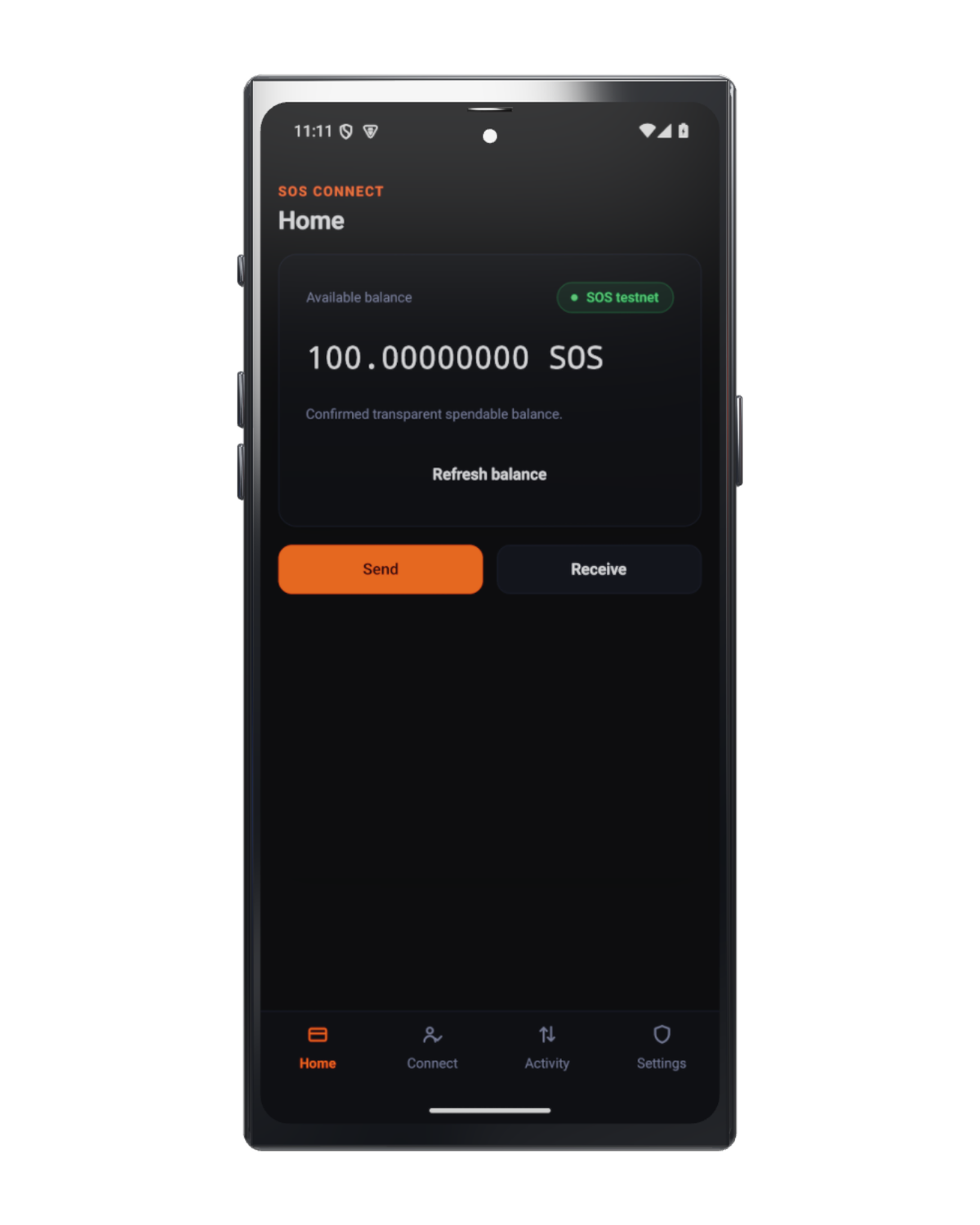
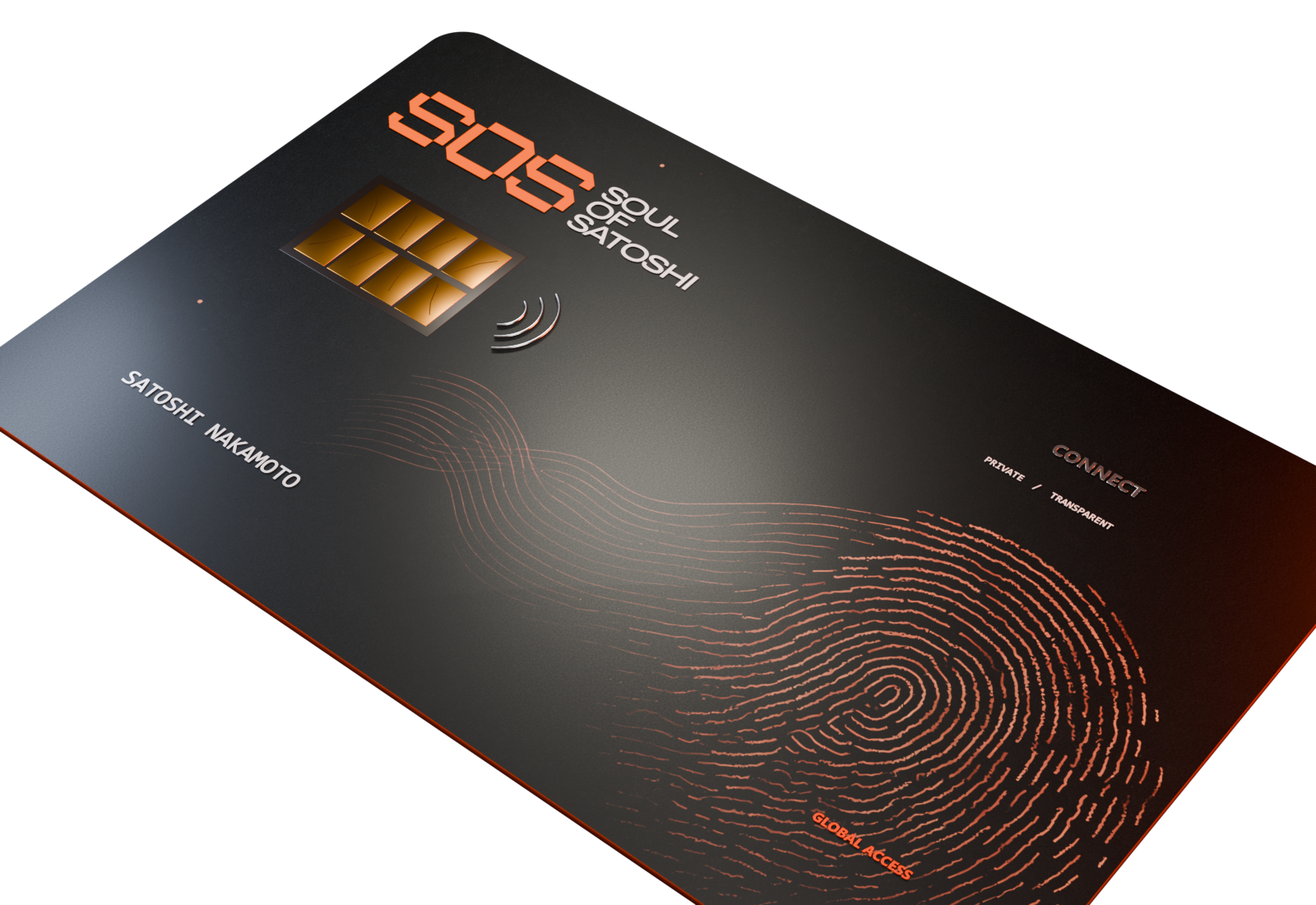
SOS Connect native Android wallet showing contact paymentsObsidian SOS Connect payment card concept with the official Soul of Satoshi identity
ANDROID PILOTActual app interface. Native keys. Chain settlement.
SOS CONNECT / NATIVE SELF-CUSTODY

Pay the person. The address stays underneath.

Verified phone aliases connect to wallet-signed payment profiles. Contact names remain local to the device, while SOS handles settlement underneath.

One Network, Multiple Forms of Value

A coherent path from settlement to useful applications

01

Secure

SOS pays fees, secures consensus and preserves its own fixed monetary policy without becoming the accounting unit for every asset.

02

Move

Transfer native and bridged value with explicit asset identity, fast BFT finality and optional private settlement.

03

Program

Build bounded public or private application logic on deterministic, consensus-bound execution.

04

Use

Reach people through products such as SOS Connect while addresses, keys and settlement remain self-custodial.

For Builders

Start with applications that need the whole network.

Multi-asset value, optional privacy, scoped disclosure, deterministic execution and a proof-verified capital route are most useful when designed together.

Independent research track

Shared private state and FHE remain a separate research line. They are not presented as part of the activation-gated VM.

01

Private multi-asset payments

Asset registry, relayers and scoped disclosure for payments that can be private to the public while remaining auditable by authorized parties.

FOUNDATION
02

Confidential treasury

Recurring payments, Agent Mandates and policy-bound execution without exposing every operational balance or instruction.

PRIORITY
03

Batch RFQ

Convert the assets used by a treasury through bounded requests for quotation before introducing shared liquidity pools.

PRIORITY
04

Sealed markets

Sealed auctions, Forecast markets and RWA delivery-versus-payment using private intent with verifiable settlement.

APP LAYER
05

Bilateral finance

Credit, receivables and parametric insurance with explicit counterparties, assets, conditions and settlement authority.

APP LAYER
06

Shared liquidity

AMMs, pooled lending, options and higher-TVL products only after the narrower primitives and risk controls are proven.

LATER

Mainnet Technical Specifications

Full-spec Mainnet V1 architecture

Network and consensus
ConsensusHotStuff BFT Proof-of-Stake
Protocol time5-second slots; skipped slots permitted
FinalityDeterministic >2/3 stake-weighted BFT commit
Reward epoch120,960 slots · exactly 7 days
Unbonding362,880 slots · exactly 21 days
Post-quantum cryptography
SignaturesML-DSA-65 · FIPS 204 · NIST Level 3
Key exchangeML-KEM-1024 · FIPS 203 · NIST Level 5
HashingSHA3-256 + SHAKE-256 · FIPS 202 · globally domain-separated
PrivacyPQ-MWEB multi-asset shielded notes · opt-in
Proof architecture
Proof systemTransparent hash-based STARKs · no trusted setup
FRITwo-adic FRI commitments · Keccak-f[1600] Merkle
Native AIRPlonky3 / BabyBear · bit-exact batched ML-DSA-65 verification
zkVMRISC Zero rv32im · recursive receipts · journal-as-truth
Guest identityNetwork-bound, ceremony-pinned ELF hashes and image IDs
Internal receiptsBare hash-based STARK receipts only
Ethereum boundaryGroth16 / BN254 wrap only where Ethereum verification requires it
Execution, assets and interoperability
AssetsCanonical network-bound AssetId registry + independent supply
ExecutionDeterministic restricted-Wasm VM
Private appsAtomic private intent + public handler + asset-aware settlement
State commitmentVersioned SHA3-256 app hash binding asset, privacy and VM roots
DisclosureFull viewing keys + scoped, revocable, non-spend capabilities
Recovery24-word seed · deterministic scan, rescan and witness recovery
BridgeBidirectional proof-verified SOS ↔ Ethereum routes
Bridge safetyPer-route TVL caps · pause, rotation and drain · fail closed
Economics and implementation
Fee assetSOS · explicit paymaster sponsorship supported
Supply cap21,000,000 SOS
Mainnet distributionPending owner-approved source of truth and legal review
Emission210,000 SOS / year
Emission split70% stakers · 20% operators · 10% treasury
Fee burn30% of each fee
LanguageRust
Contract toolchainRust → deterministic restricted Wasm

Target launch architecture for SOS Mainnet V1. These parameters describe the final network, not the current public testnet.

Network Status

Live from the SOS network

--
Block Height
--
Validators
--
Peers
--
Circulating SOS
Public releases, independently verifiable

Built by the Community

78% of SOS is emitted to the people who secure and use the chain. The genesis allocation — sales, team and treasury — is disclosed and protocol-vested. Public node releases are signed, checksummed and independently verifiable while mainnet-candidate systems move through review, reproducibility and external-audit gates.

Roadmap

Progress measured by evidence and activation gates

LIVETestnet
PILOTConnect
VALIDATIONCandidate
PREVIEWBuilders
GATEDMainnet

Public Testnet

LIVE
  • Post-quantum consensus and transactions
  • Optional PQ-MWEB privacy
  • Staking, wallet and explorer
  • Proof-verified Ethereum bridge

SOS Connect Pilot

LIVE
  • Native Android self-custody
  • Verified contact payments
  • Biometric transaction approval
  • Independent 24-word recovery

Mainnet Candidate

NEXT
  • Canonical multi-asset registry
  • Independent asset supply accounting
  • Multi-asset bridge V2
  • VM state and deterministic execution

Developer Preview

  • Reviewed SDK and contract model
  • Public and private app templates
  • Forecast and treasury reference apps
  • Independent application devnet

Partner Rollout

  • Bridged stable-asset pilot
  • Regulated fiat on/off-ramp
  • Virtual card, then physical card
  • Availability subject to partners

Mainnet Genesis

  • Independent security audits
  • Validator and operator readiness
  • Genesis and bridge ceremony
  • Activation of approved VM profile

The Team

Protocol engineering, product delivery and verifiable releases.

Shutaru

Shutaru

Lead Developer

Rust maximalist. Sleeps in vim.

MrYoda

MrYoda

Strategy & Tokenomics

If the math checks out, ship it.

Jehuty

Jehuty

Protocol Engineering

Breaks consensus, then fixes it better.

TateTuga

TateTuga

Security & Infra

Reads NIST papers for fun. Paranoid by design.

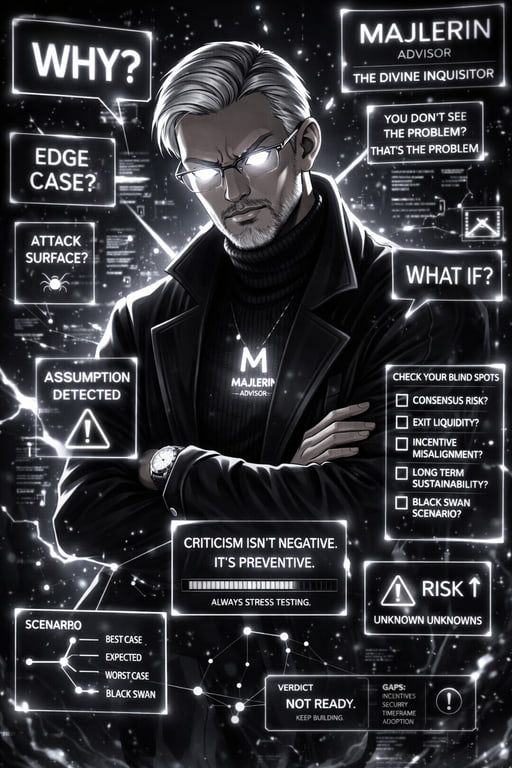
Majlerin

Majlerin

Devil's Advocate

If it can break, he'll find out why.

Ze Gato II

Ze Gato II

QA & Community

Breaks things so you don't.

Quantum Threat Monitor
Live · countdown to the earliest credible Q-Day estimate
Days
Hours
Min
Sec

to Q-Day — the projected arrival of a cryptographically-relevant quantum computer able to break RSA-2048 / ECDSA. Counting down to the earliest credible “first impact” estimate: Jan 2029 (Google's ~2029 target). The field's range runs later — to ~2035+ and beyond; see the forecasts and estimate band below.

SOS Status
SAFE
ML-DSA-65 · ML-KEM-1024
SHAKE-256 · NIST FIPS 203/204

SOS crossed Q-Day at genesis — post-quantum from block 0. The countdown is for everyone else.

When could Q-Day arrive?2026 → 2045
2026TodayYou are here
~2030Migration deadlinesNSA · NIST · White House EO
2035Median estimateExpert median · GRI survey
~2044ConservativeGlobal Risk Institute ~79%
Mosca's Inequality — why the countdown matters before it hits zero

If the time your data must stay secret (X) plus the time you need to migrate (Y) is greater than the time until Q-Day (Z), you are already exposed. “Harvest-now, decrypt-later” lets an adversary capture ECDSA-signed transactions today and break them after Q-Day. SOS sets Y = 0: it was post-quantum from block 0.

Latest Intelligence

Sources: Global Risk Institute, NIST, NSA, Google Quantum AI, IBM, Microsoft, The White House. Forecasts are estimates, not predictions — informational only, not financial advice.

Full intelligence report →
“We hope quantum attacks never come. But if they do, everyone deserves post-quantum money.